The Quiet Case for Financials
Memo #001, published in late May, was written in the aftermath of a ceasefire. The Strait of Hormuz had reopened to a fraction of its normal traffic, oil had retreated from its wartime peak, and the thesis was straightforward: markets had priced in a Fed forced to hike indefinitely, and we believed that pricing would not survive a durable reopening of the Strait. Eight weeks later, the durable reopening has not arrived. It came, briefly, and then it came apart.
Fighting between the parties resumed roughly ten days ago, and the ceasefire that anchored our earlier thesis is, at minimum, in question. This is not the story we expected to be writing in July. But it is the story worth writing, because the market's own behavior over these same eight weeks has quietly contradicted the fear that a reignited conflict was supposed to produce. We think that contradiction is the real signal, and we intend to spend this memo explaining why.
The numbers are worth stating plainly, because they describe a genuine deterioration, not a rounding error. Before the original conflict began, roughly 120 tankers transited the Strait of Hormuz each day. By the time we wrote Memo #001, that figure had recovered to approximately 40 per day under the weight of an active ceasefire — meaningful progress, though still a third of normal capacity. Today, with fighting resumed, daily transits have fallen back to somewhere between eight and ten. We are, by this measure, in worse shape than we were at the time of our last memo, not better.
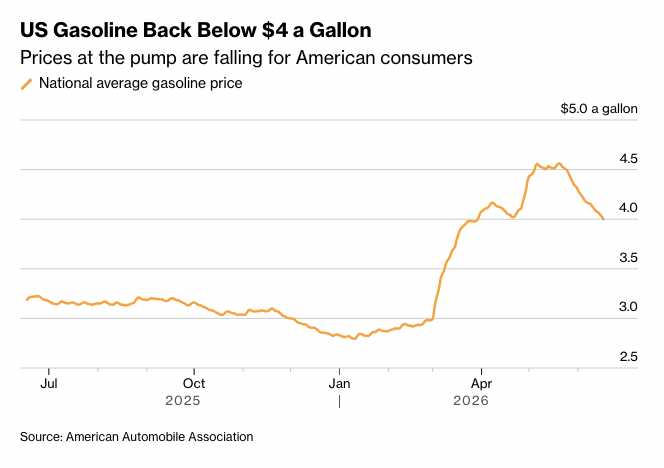
Oil has moved in step. Crude traded in the mid-$60s per barrel during the calmer stretch this spring. It now sits in the mid-$80s, a substantial repricing that reflects the market's judgment that supply through the Strait is once again constrained. For the American consumer, this shows up first and most visibly at the pump, and the national average gasoline price has tracked the round trip closely — falling back below the $4 mark during the ceasefire window before beginning to firm again as the conflict reignited.
We raise this not to understate the risk, but to be precise about it. Our thesis in this memo does not depend on pretending the Strait situation has resolved. It has not. What we are arguing is narrower and, we think, more durable: that even against this genuinely uncertain backdrop, the market's response in equities has already begun to look past the headline and toward something else entirely.
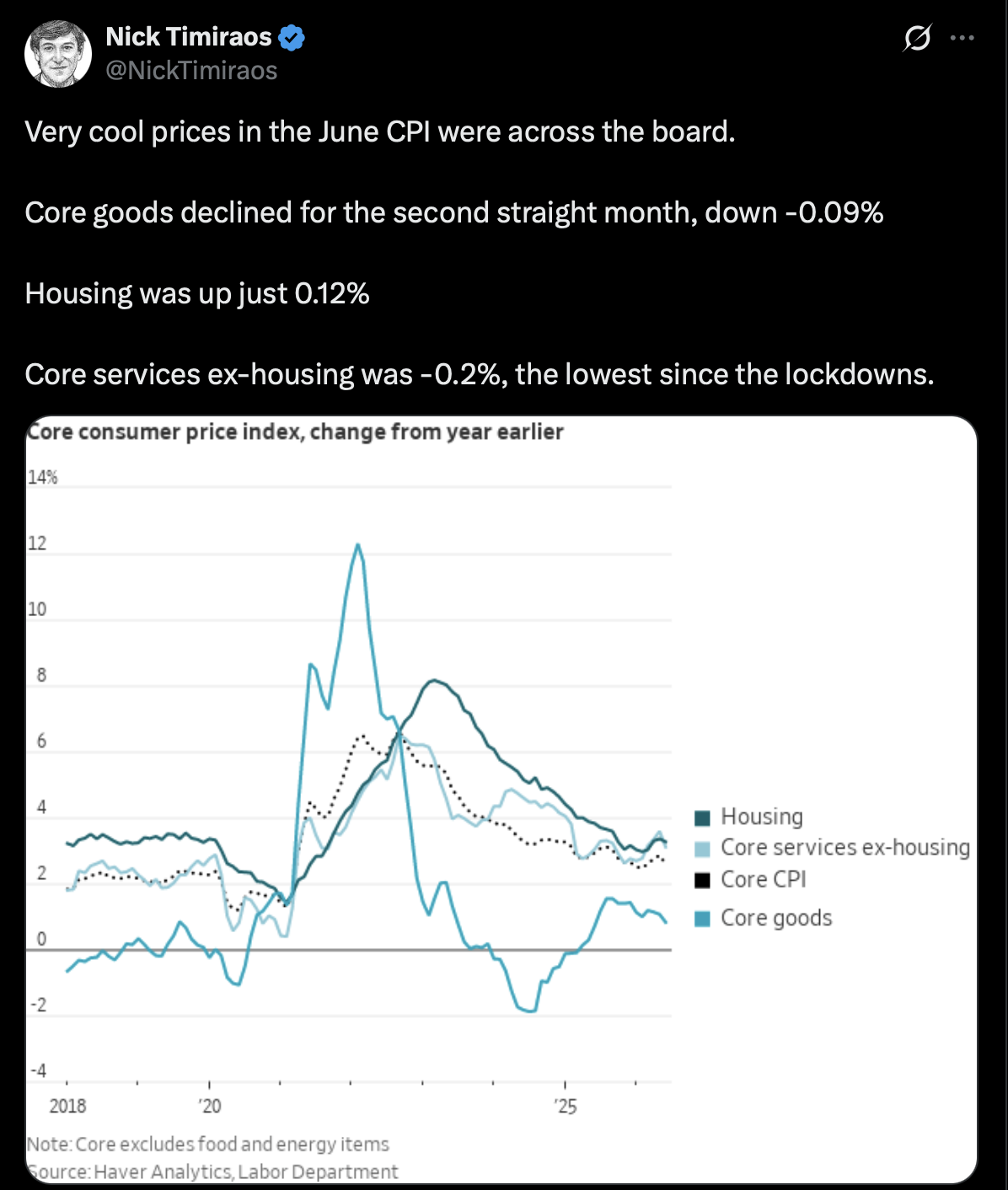
The June CPI print, released in the middle of this window, was unambiguously soft. Core goods prices fell for a second straight month. Housing costs rose just 0.12%. Core services excluding housing came in at negative 0.2%, the lowest reading since the pandemic lockdowns. Taken at face value, this looks like an economy where inflationary pressure is fading, not building — and if that were the whole story, the case for further Fed tightening would be difficult to make.
But the timing matters. That print reflects a period when oil was still trading in the mid-$60s, before the current round of fighting pushed crude back toward $85. Energy costs move through the broader price level with a lag of a month or two, not instantly, and the softness in June's data is in large part a function of the calmer environment that preceded it — not a verdict on the environment we are in now. This is precisely why the market has not relaxed on rate policy despite a genuinely encouraging print: the inflation data is looking backward at a moment that has already changed.
We think this distinction is being lost in most of the commentary we have read on the print. A soft CPI reading and a hawkish Fed are not, in this instance, in conflict with one another. They are describing two different months.
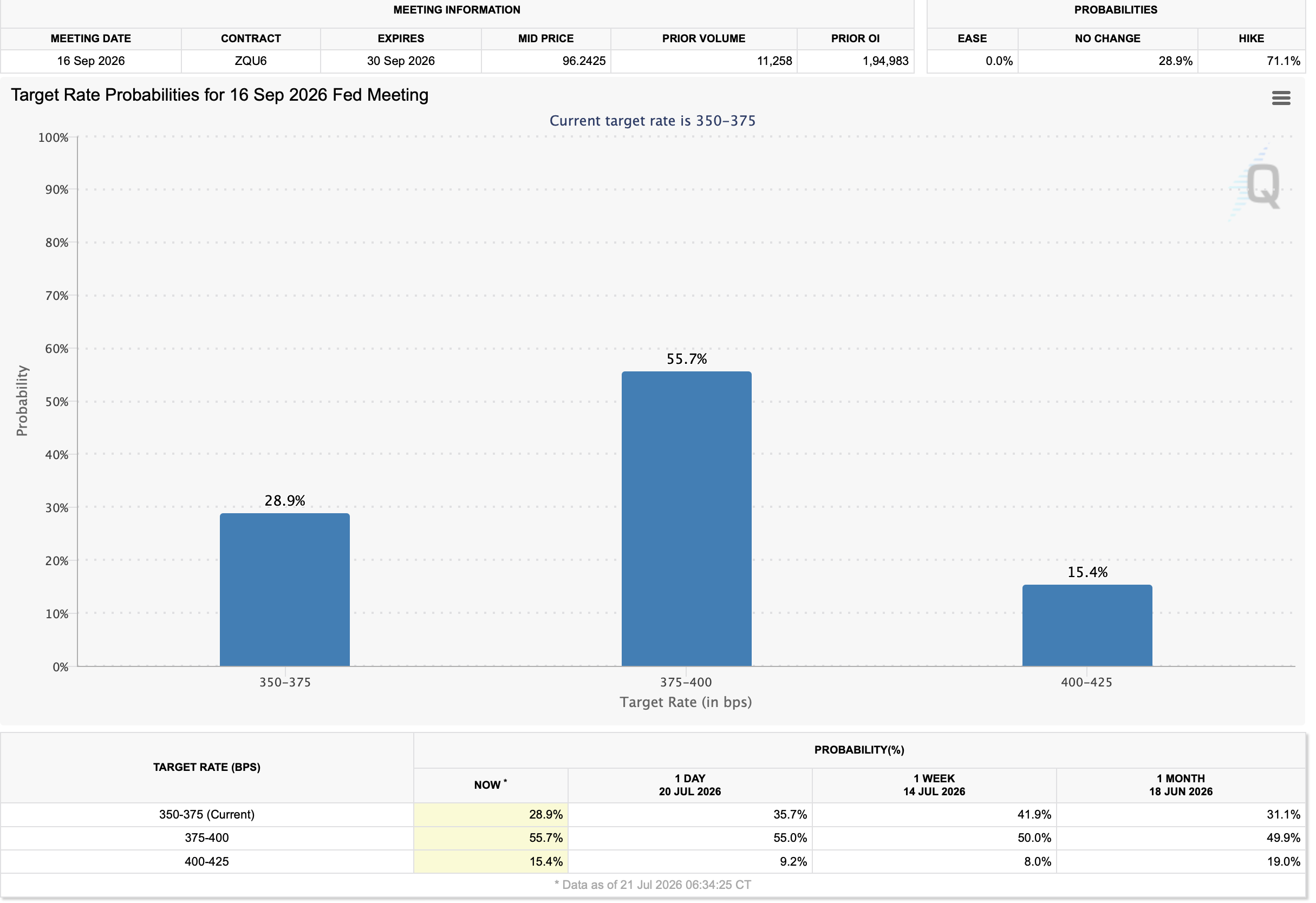
The CME FedWatch Tool leaves little room for interpretation. As of this writing, the probability of a rate hike at the September 16 meeting stands at 71.1%, up meaningfully from just a week earlier. The probability of a rate cut, at that meeting or any other on the board, is zero. This is not a market debating whether the Fed eases — that debate ended some time ago. It is a market debating how much further the Fed has to go in the other direction.
Taken on its own, this ought to be unambiguously bad news for financials. The conventional view, which we ourselves relied on in Memo #001, holds that rate hikes compress net interest margins, dampen loan demand, and generally punish rate-sensitive sectors. If that view were fully correct, we would expect financials to be among the worst-performing corners of the market right now. They are not.
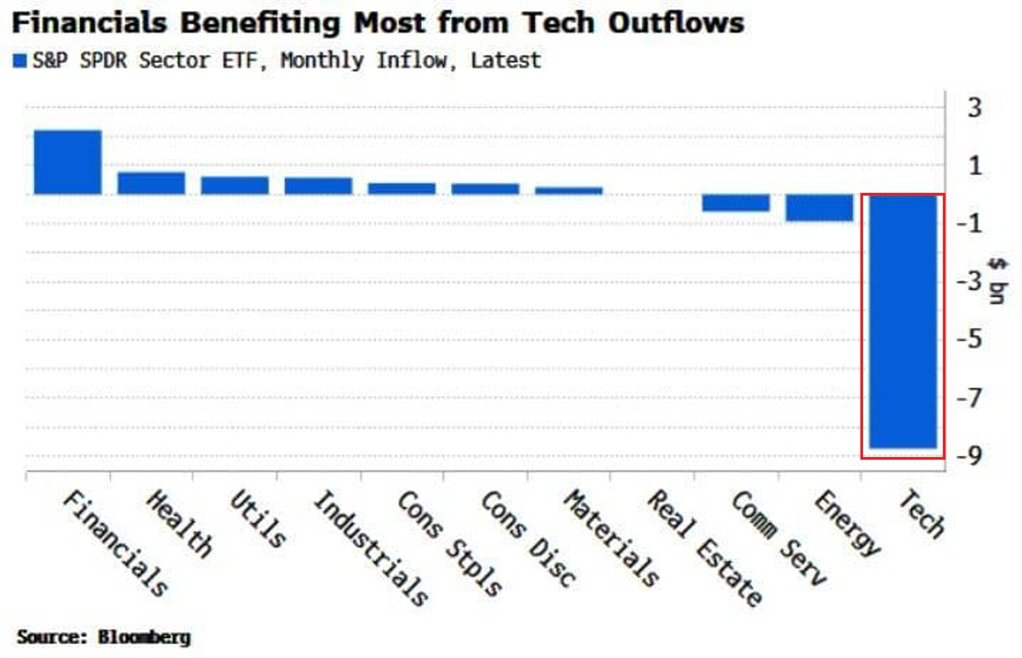
Over the trailing month, the Financial Select Sector SPDR ETF (XLF) has outperformed the Nasdaq-100, even as hike odds have climbed and the Strait situation has deteriorated. This is not a marginal divergence. Flow data tells the same story from a different angle: financials have absorbed the largest inflow of any S&P sector over the same period, while technology has suffered outflows on the order of $8-9 billion — by a wide margin the worst of any sector tracked.
We want to be direct about what this means. If the market genuinely believed that hikes were coming and that hikes would hurt financials the way the textbook says they should, capital would be leaving the sector, not arriving in size. It is not. Something else is doing the work here, and we think it is worth naming precisely rather than waving at vaguely.
The explanation, in our view, sits in the earnings data rather than the policy data. S&P 500 bottom-up consensus EPS estimates for calendar year 2026 have moved from roughly $300 per share in June of last year to nearly $339 today, a revision of 13%. The 2027 estimate has moved from $338 to just over $392, a revision of 16%. These are not small adjustments, and critically, they have occurred continuously through the entire period we have just described — through the original conflict, through the ceasefire, and through its recent breakdown.
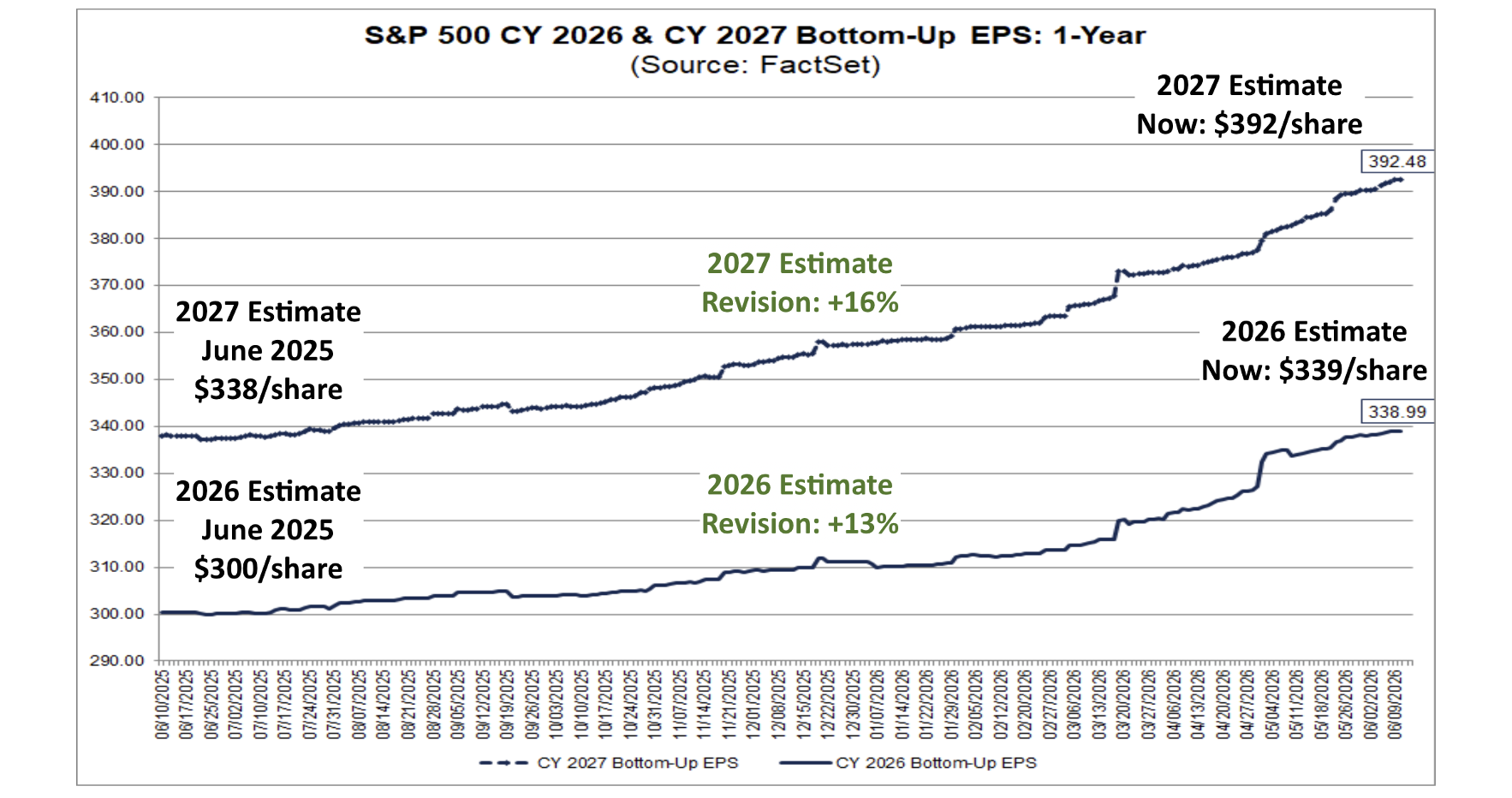
This is the core of our house view, and it applies as directly here as it did in Memo #001: stocks follow earnings. Fed policy sets the discount rate applied to those earnings, and it matters, but it is not the primary driver of where capital goes when the underlying businesses are demonstrably improving. Financials are working right now for the same reason they eventually re-rated after our original thesis — not because the market has decided rates are falling, but because the earnings power sitting underneath the sector has continued to strengthen regardless of what the Fed does next. A rate hike is a headwind. It is not, on its own, a reason for a well-earning business to be repriced lower, and the market appears to have quietly arrived at the same conclusion well ahead of the commentary written about it.
We are not making a prediction about what the Fed does at any single meeting, and we think that is the wrong question to organize a portfolio around. Our positioning is built on a twelve to eighteen month view, and the case for financials over that horizon does not require the Fed to cooperate. It requires only that the earnings trend documented above continues, which is a considerably easier thing to underwrite than a specific path for interest rates.
There is a second, more conditional case layered on top of the first, and we want to be clear that it is a bonus to the thesis rather than its foundation. If the current fighting subsides and the Strait resumes its recovery, oil should retreat again, and the disinflationary trend visible in June's data would have room to reassert itself without the lag we described earlier working against it. Under that scenario, the Fed's hiking bias would likely soften, and a sector already outperforming on earnings alone would gain a second tailwind it does not currently need. We would welcome that outcome. We are not depending on it.
It is also worth noting, briefly, that financials sit outside the concentration risk that has defined this market cycle. Should sentiment around artificial intelligence infrastructure spending ever turn sharply, sectors with durable earnings and limited exposure to that narrative — financials among them — are the more likely destination for capital in retreat, not an afterthought. We mention this as a secondary consideration, not the reason we hold the view.
The rotation we have described in this memo has already happened, in the flow data if not yet in the consensus narrative. Investors waiting for confirmation that the Fed's hiking bias has ended will be buying into a sector that has already re-rated on the numbers that actually matter.
Disclosure: Double Eleven Capital holds no position in the Financial Select Sector SPDR ETF (XLF) as of July 22, 2026. The partnership may hold positions in individual companies within the financial sector.